Mexican Federal Army
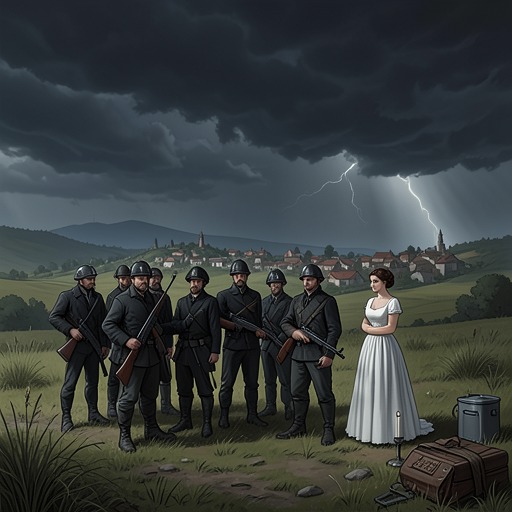
Like Water for ChocolateFederal troops appear in the novel less as a fully described institution than as an armed presence whose movements reach into private life. Their occupation of a village helps make ordinary travel dangerous; their clashes with rebel forces kill a village nurse; and one of their soldiers detains Pedro when he is trying to bring a doctor to a birth. Across these episodes, political conflict is registered at the ranch through interrupted journeys, endangered care, and uncertain news.
Presence in the Revolutionary Conflict
The narrative places federal forces within an ongoing conflict with rebels, but does not supply a formal account of their organization, leadership, or wider military objectives. Instead, it identifies their presence through particular consequences. After federal troops occupy the village, conditions are too dangerous for Mama Elena and Chencha to make an earlier trip to obtain supplies for the expected birth. Their delayed return becomes crucial when Rosaura goes into labor unexpectedly, leaving Tita to care for her.
The distinction between federal forces and rebels matters throughout these scenes. When a rebel troop later approaches the ranch, the household prepares for that arrival as a separate threat. The novel thus presents the ranch as exposed to a conflict involving opposing armed groups, rather than treating every soldier as part of a single undifferentiated force. Its attention, however, stays with the household’s vulnerability rather than the political causes of the fighting.
The Birth and the Cost of Interrupted Care
During Rosaura’s labor, Pedro leaves to seek Dr. Brown, the family doctor. He is captured by the federales and detained, so he cannot bring the doctor back. At the same time, shooting in the village prevents Mama Elena and Chencha from returning; they have taken refuge with the Lobos. These separate disruptions leave Tita alone at the birth of her nephew.
The episode makes military force consequential without placing a battle at its center. Tita has prepared sheets, hot water, and sterilized scissors, but has no practical knowledge of delivering a baby. She finds Rosaura gravely unwell and struggles to help her. In recalling her schooling, Tita condemns its failure to prepare her for the urgent task at hand. The crisis therefore links political instability to a domestic emergency: the troops do not simply occupy the distant background, but help determine who can reach the bedside and who must manage without trained assistance.
Clashes and Civilian Consequences
The danger is not confined to the ranch or to a single military force. A wet nurse from the village, a relative of Nacha who has recently had her eighth child, feeds Rosaura’s baby for a month. She is mortally wounded by a stray bullet while traveling to visit her family, in a battle between rebels and federal troops. Her death removes the infant’s source of milk, and Chencha’s unsuccessful search for another nurse leaves the household facing the immediate problem of how to feed him.
The sequence connects armed conflict to the fragile work of caregiving. The nurse is not presented as a combatant, and the account does not attribute the stray bullet to either side. Its stated cause is the battle itself. The result is nevertheless specific: a person sustaining a newborn’s life is killed, and the household must respond to a loss produced by violence beyond its control.
Rumor, Resistance, and the Limits of the Record
Federal troops also enter the story through an account that is explicitly invented. After Gertrudis runs away with one of Villa’s men, Tita must answer Mama Elena’s questions. She claims that federal forces have descended on the ranch, set fire to the bathroom, and kidnapped Gertrudis. Mama Elena believes the story, but later learns from Father Ignacio that Gertrudis is working in a brothel on the border. She burns Gertrudis’s birth certificate and photographs and forbids the family to speak of her. The supposed federal raid is therefore not evidence of an actual operation; it is Tita’s cover story, and its consequences fall on the family’s treatment of Gertrudis.
Elsewhere, Mama Elena’s response to an approaching rebel troop shows how reports of violence shape her preparations. Having heard from Father Ignacio and the mayor of Piedras Negras that rebels enter homes, destroy property, and rape women, she hides Tita, Chencha, and a pig in the cellar and goes to meet the soldiers armed with a shotgun. That encounter concerns rebels, not federal troops, but it clarifies the atmosphere in which the federal occupation and the battles between the forces are experienced: danger is anticipated through news, and decisions inside the home are made under its pressure.
The novel’s account of federal forces remains deliberately close to its household-scale effects. It records an occupation, Pedro’s detention, and a fatal battle, but supplies neither a broader military history nor grounds for assigning every harm to a single side. This limited perspective makes the conflict legible through what it interrupts: a journey for medical help, a return from the village, and the care on which a newborn depends.